





The ICARUS experiment (Imaging Cosmic And Rare Underground Signals) studies the properties of neutrinos, searching for the sterile neutrino.
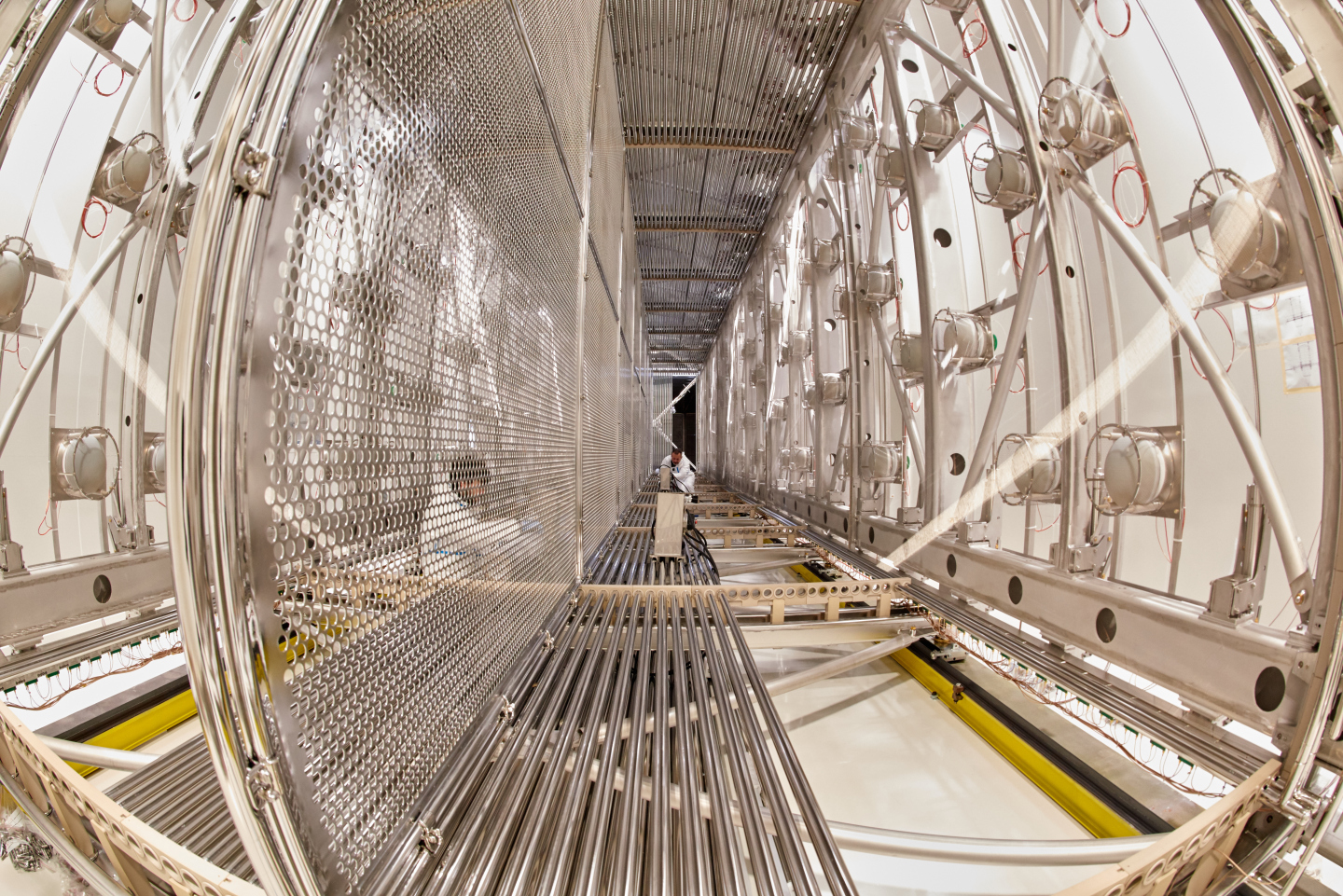
The ICARUS Liquid Argon Time Projection Chamber (LAr-TPC) detector, designed by Carlo Rubbia in 1977, has an active mass of approximately 500 tons of liquid argon and is currently in operation at Fermilab in Chicago.
After an initial data-taking phase at the Gran Sasso National Laboratories (2010-2013), the detector was transferred to CERN for a major technological upgrade program, improving its performance in terms of temporal resolution, argon purity, and operational stability. In 2021, ICARUS started taking data with the neutrino beam of the Short-Baseline Neutrino program at Fermilab.
The primary objective of the experiment is to verify the anomalies observed in previous experiments by searching for possible neutrino oscillations attributable to the existence of sterile neutrinos. ICARUS also contributes to precision measurements of neutrino cross sections in argon and to the development of advanced reconstruction techniques, playing a key role as a testbed for future liquid-argon detectors, such as the DUNE experiment.
The ICARUS collaboration, historically led by Nobel Prize winner Carlo Rubbia, brings together more than 100 scientists from 22 institutions.
The ICARUS group in Catania is involved in the optical detection system, based on photomultipliers. Activities include photomultiplier energy calibration and the study of photomultiplier gain stability under cryogenic conditions, with dedicated laboratory tests.
The group contributes to the development activities for the DUNE experiment, particularly for the Vertical Drift detector, and to the test of the DUNE detector prototype at CERN.





 Subscribe to RSS Feed