





The SND@LHC experiment (Scattering and Neutrino Detector at the LHC) studies neutrinos produced in proton-proton collisions in the LHC accelerator at CERN.
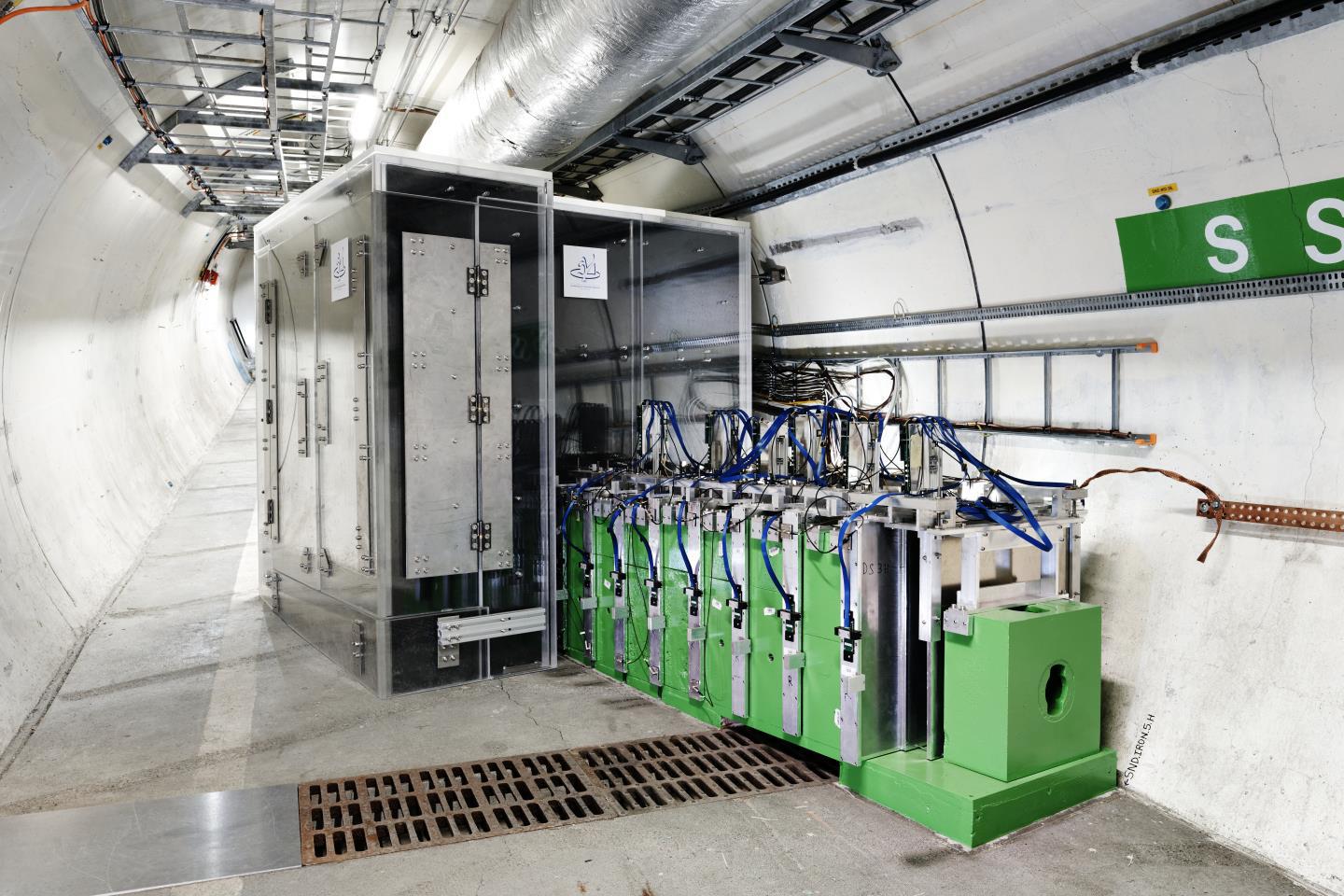
The current SND detector is located approximately 480 meters from the ATLAS experiment interaction point, in an underground tunnel slightly inclined with respect to the beam axis. This allows to collect data in an angular region previously unexplored by other LHC experiments.
The experimental setup is optimized to detect very high-energy neutrinos, produced primarily by the decays of heavy quarks. The detector consists of tungsten plates interspersed with photographic emulsion plates for extremely high-resolution tracking, followed by a calorimeter for energy measurement and a muon identification system. The combination of these subdetectors allows for the precise reconstruction of the neutrino interaction vertex and the distinction between neutrino signals and possible weakly interacting particles, potential candidates for light dark matter.
SND began data collection in 2022. Data analysis led to the first direct observation of neutrinos produced at a collider, inaugurating a new field of neutrino physics. Analysis activities include precision measurements of the fluxes and interactions of neutrinos of all flavors and searches for signals of new physics.
The current SND detector will be completely replaced by a new, upgraded version, in preparation for high-luminosity data collection starting in 2030.
The SND collaboration brings together approximately 200 researchers from numerous international institutes, with a key contribution from the INFN.
The newly formed SND group in Catania intends to contribute to the upgrade of the SND detector, particularly the new vertex detector with silicon microstrip planes derived from the CMS tracker. In parallel, there will be analysis of data collected over the years.





 Subscribe to RSS Feed